Our History
- About Us
- Accommodations
- Cruise Cayuga
- FAQ
- Finger Lakes
- Food & Wine
- Homepage
- Inns of Aurora Newsletter
- Meetings & Events
- Mom’s Night Out!
- Reservations
- Testimonials
- Weddings
Aurora Inn
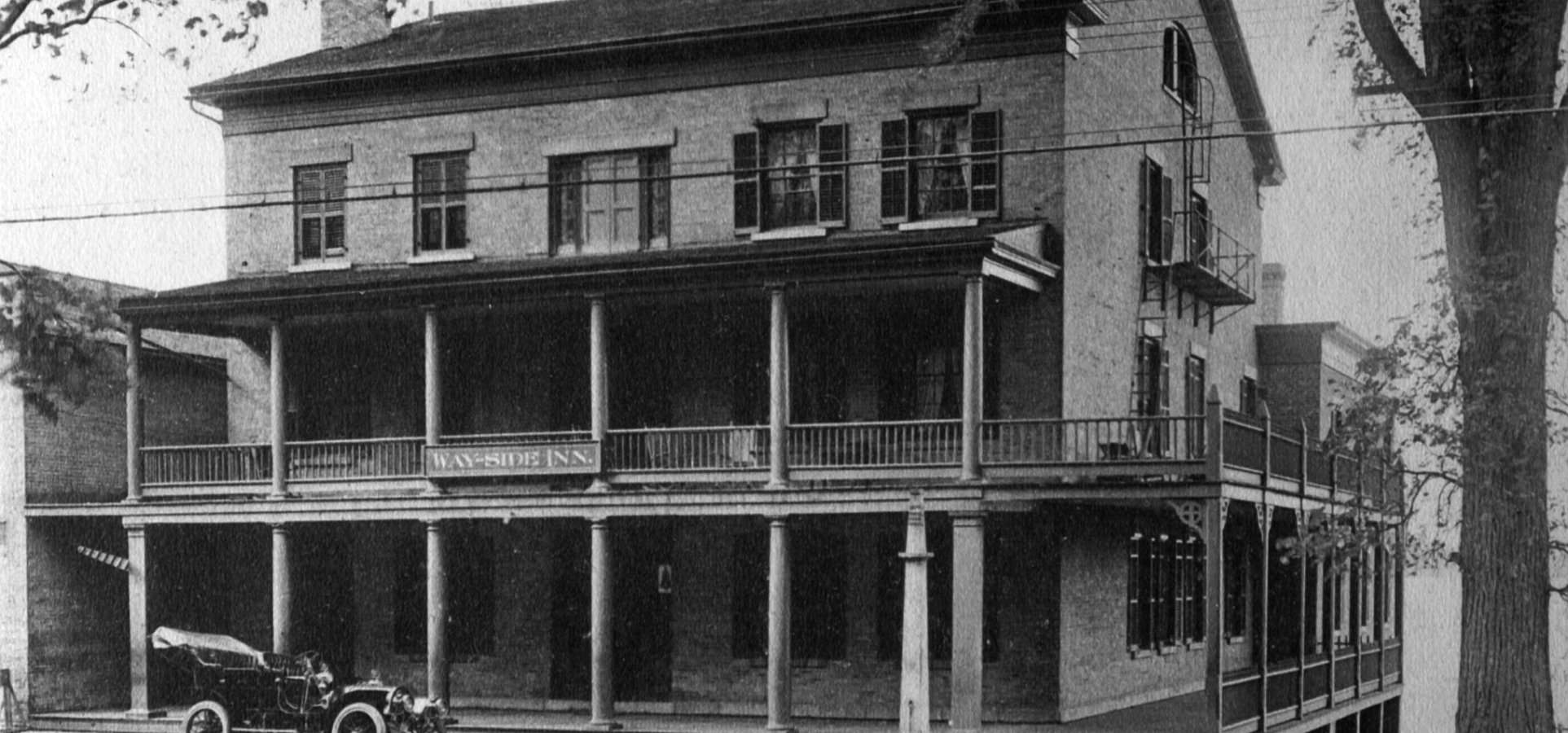
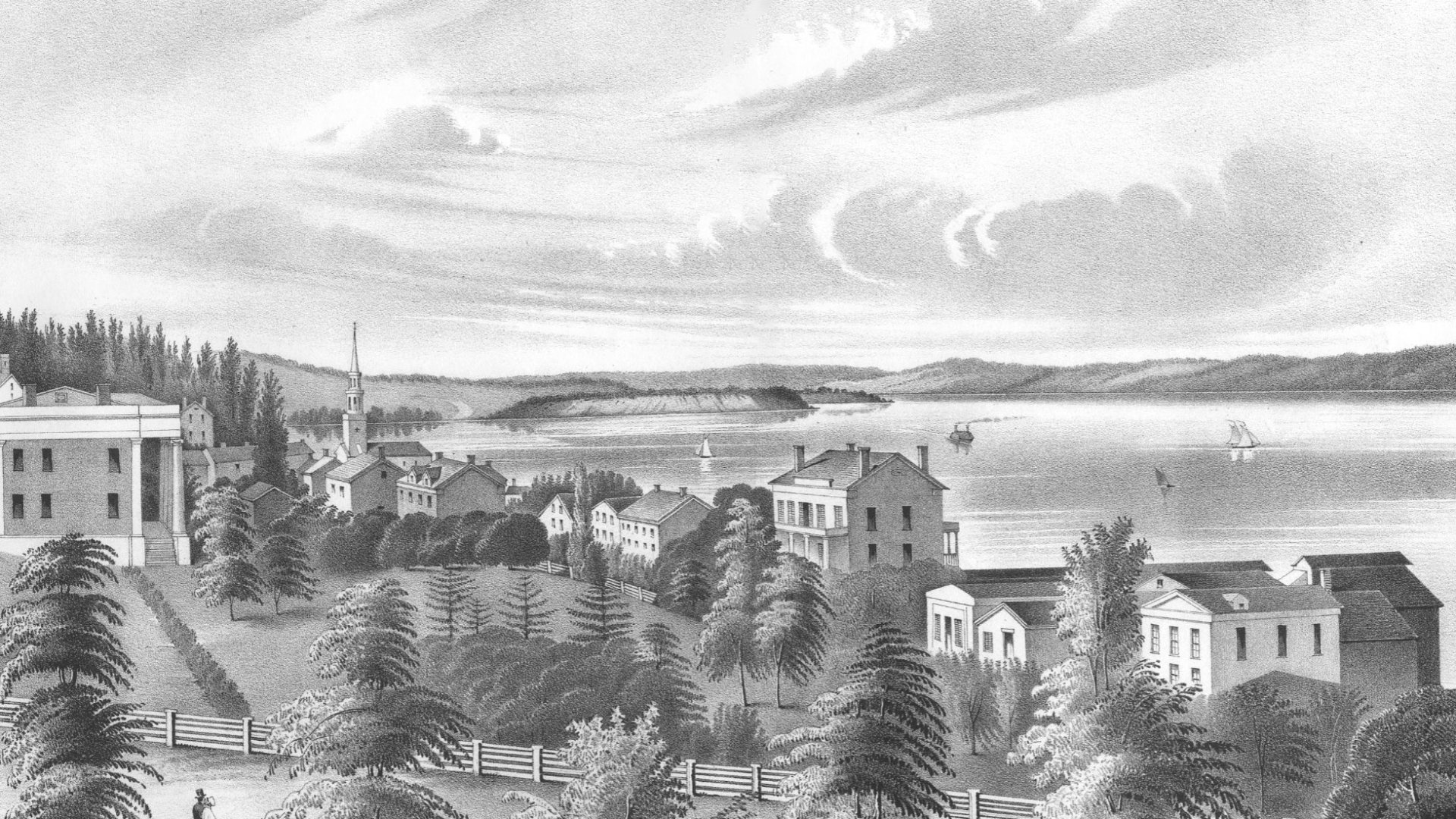
Originally named Aurora House, the Aurora Inn was built in 1833 by Colonel E. B. Morgan, a native of Aurora and original investor in The New York Times. By the mid-19th century, Aurora became a major stop on the Erie Canal for boats carrying agricultural products from area farmers to New York City. Henry Wells, of Wells Fargo stagecoach fame and the founder of American Express, established Wells College there in 1868.
During its colorful past, the Aurora Inn was a favored overnight destination for travelers borne by coach, canal boat and rail. It has long been a popular gathering spot for students from Wells, Cornell University and other nearby colleges. In the early 1840s, William D. Eagles purchased the Inn and engaged his uncle John Eagles, a former sea captain, to manage it for him.
When a fire destroyed the main building at Wells College in 1888, many students lived temporarily at the Aurora Inn, which they renamed the Wayside Inn. Fire struck again on February 18, 1919, destroying Aurora’s tiny business district between the old post office and the Aurora Inn. When the south cornices of the Inn caught fire, Wells College President Kerr Duncan McMillan climbed onto the roof and helped to douse the blaze.In 1943, the Inn was deeded to Wells College. Despite a series of additions, renovations and new managers, from the 1970s, the Inn faced financial struggles. A drain on the college’s resources, it was closed several times during the last three decades, most recently in October 2000.
E.B. Morgan House
One of Aurora’s most notable and distinctive landmarks is the former home of Edwin Barber Morgan, his wife Charlotte Wood Morgan, their children, and succeeding generations of the Morgan-Zabriskie family. The residence, designed in the Italianate style, was constructed between 1857 and 1858 for $50,000, a staggering sum in that era.
E.B. Morgan (1806-1881) was born in Aurora and attended the local Cayuga Lake Academy. At an early age he showed considerable business acumen, working at his father’s store in the heart of the village that was, during his youth, a bustling port. On the commercial dock that once stood behind the Aurora Inn, Morgan first met his lifelong friend and partner in both business and philanthropy, Henry Wells (1805-1878). Having generated capital from the lake trade, Morgan built the Aurora Inn in 1833 and was an early investor in Henry Wells’ American Express Company as well as Wells, Fargo & Company, which included the stagecoach line that has become a national symbol of the pioneer spirit. Morgan also invested in many local enterprises, including the construction of steamboats and the Oswego Starch Company.
Both Morgan and Wells were friends and business partners with a prominent citizen of nearby Ithaca – Ezra Cornell (1807-1874), a self-taught mechanic and inventor who became the largest stockholder of the Western Union Telegraph Company and founded Cornell University. Morgan and Cornell invested in the Cayuga Lake Railroad Company in the 1870s; it ran through Aurora along the lakeshore. Many waterfront homeowners might find this a detriment; Morgan saw it as an opportunity to monitor his investment. Reportedly, he stood with a watch and checked the train’s punctuality when it passed through his yard.
Another of Morgan’s investments was in a fledgling New York City newspaper. Within a few years, he held controlling shares of the New York Times. He supported the paper in its efforts to expose the corruption of the notorious Tweed Ring, which led to the arrest and imprisonment of “Boss Tweed.” Surrounded by friends and family in his beloved home on Cayuga Lake, Morgan’s later years were increasingly devoted to supporting local philanthropic causes in the area of education, culture, and human welfare. He had a deep love for the people of Aurora and every year on the Fourth of July holidays, the Morgans treated the villagers to a spectacular fireworks display on their lawn.
Morgan was a dedicated supporter of Henry Wells’ dream to establish a liberal arts college for women in Aurora—Wells College—that first opened as a seminary in 1866. He gave generously to the college, including $100,000 to establish its endowment. He was a Wells trustee and provided leadership in all aspects of college administration. He was also president of the Cayuga Lake Academy for more than 25 years, a trustee of Cornell University, and generous contributor to the Auburn Theological Seminary, a leading institution of its time.
Following E.B. Morgan’s death, the mansion became the home of his daughter, Louise, and her husband Nicholas Lansing Zabriskie. It remained a Morgan-Zabriskie family residence until 1961 when it was given as a gift to Wells College by John L. and Lesley Zabriskie. It served as a residence hall for students studying French—only French was allowed to be spoken inside. E.B. Morgan’s former home was so conducive to the mastery of French that it remained in use for that purpose until the 1973-74 academic year. During that time it became known as French House in the village, a designation still used by local residents today. French House was renovated in 1979 and served as a college guest house for a quarter century.
Leffingwell House
The Leffingwell House sits in the center of the tiny village of Aurora, (population 400) overlooking Main Street and Cayuga Lake. Although the historic structure has only had four owners since it was built, this artfully restored home houses a bounty of history.
Constructed in the Federal style in 1826, the house was built by its original owner, Edwin Burnham. A lawyer, Burnham’s law office is still standing today – the small brick house across the street from Leffingwell House is where Burnham stored his law library. President Millard Fillmore’s first law office, where he studied under Burnham years before being elected president, is located next to Leffingwell House.
Upon Burnham’s death the house passed into the hands of his nephew who enlarged the house in keeping with the popular Victorian style. The house was sold to Albert Leffingwell in 1895. Both Doctor Leffingwell and his wife were physicians. They cared for village residents in the back half of the second floor which included a room where patients could stay. Upon commencement of the house’s restoration, the couples’ handwritten medical records were discovered along with medicine bottles they used. Albert Leffingwell also served as the United States Consul to Russia and was one of the founding members of the American Humane Society.
After Mrs. Leffingwell died in 1932, the house remained empty for decades. Pleasant Rowland, founder and creator of American Girl, purchased the property in 2001 and commenced restoration, reestablishing the original charm of this handsome home and grounds.
A Storied Past Lives On
The Aurora Foundation, a partnership between Wells College and the Pleasant T. Rowland Foundation, began a complete renovation of the Aurora Inn and E.B. Morgan House in 2001 to restore them to their former grandeur and make them appealing once again for lodging, dining and special events. The Inn and Morgan House reopened in May 2003 and July 2005, respectively, to rave reviews by visitors and media alike. Leffingwell House joined the Inns of Aurora in January of 2012. The properties now stand as crown jewels in the revitalization of Aurora, which is listed on the National Register of Historic Places, along with Wells College and many homes in the village.